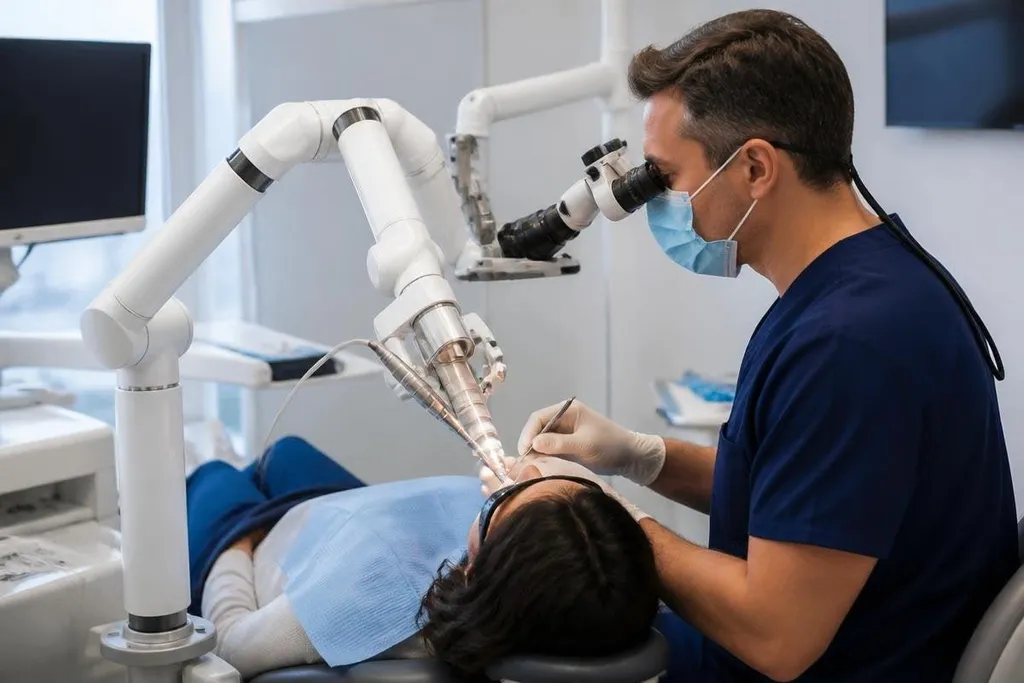
A dental robot can hold a tool steady, repeat a planned movement, or help a clinician place material with measured control. That does not make it ready for every mouth, because teeth, gums, nerves, and patients all vary.
- Early systems are likely to assist with repeatable tasks.
- A dentist will still need to plan treatment and handle exceptions.
- Clinical proof, clear safety rules, and repair support will decide adoption.
Where dental robots can help first
The first useful dental robots will likely work beside clinicians rather than replace them. Their job may be to keep a handpiece, camera, or positioning tool within a planned path while the dentist watches the patient and decides what happens next.
That division suits the setting. Its motors can repeat a motion with steady timing, but a clinician still needs to judge pain, tissue condition, bleeding, anxiety, and sudden movement. Those details can change during one appointment.
Repeatable work offers a clear starting point. A system could support scanning, tooth preparation, implant positioning, or the placement of dental materials, provided the task has a defined path and the clinician can stop it at once.
The useful question is not whether a robot can move a tool. It is whether the robot can keep the patient safe when the planned path no longer fits the real situation.
The hard part is the mouth
Dental work takes place in a small space beside a moving tongue, wet tissue, blood, saliva, and a patient who may flinch. A robot must sense that setting and respond without pushing ahead when its view or position becomes uncertain.
That calls for more than accurate motors. The system needs cameras or other sensors, a way to track its position, limits on force, and a clear stop system. The dentist also needs to see what the robot sees and understand why it has paused or changed its motion.
Patient movement creates a second problem. A rigid plan may work on a model or a scanned image, then need changes when the jaw shifts. Any dental robot used on people will need a safe way to pause, rescan, and continue without losing track of the treatment area.
Proof will matter more than a polished demo
A short demonstration can show that a robot moves a tool through a planned route. It cannot show how the system performs across different teeth, mouth shapes, lighting conditions, or unexpected movement.
A useful clinical record would need to describe the task, the patient group, the dentist’s role, the stop rate, and the errors that required human correction.
It should also show what happened after a tool, sensor, or software component failed.
That failure record belongs beside the treatment task, clinical setting, and person who can stop the system. Robot24 gives this comparison a wider robotics view, so the next test is clinical evidence strong enough for daily use.
I'd wait for published clinical results before treating a dental robot as a routine purchase. A system that works in a controlled demonstration may still need years of training data, safety checks, and service work before a clinic can rely on it each day.
What changes for dentists and patients
Dentists may spend less time holding a tool in one position and more time setting treatment plans, checking scans, and supervising the system. That shift would require training in software, sensor limits, emergency stops, and the records needed to review a robotic procedure.
Patients will need plain answers. They should know which part of the procedure the robot handles, when the dentist takes control, what happens if the system stops, and how the clinic protects their scans and treatment records.
Cost will shape access too. A robot brings the purchase price of the system, training, maintenance, software updates, and possible downtime. A clinic must compare those costs with the task it can perform and the number of appointments that need it.
A practical check before a clinic buys one
Use this checklist when a dental robot reaches the sales stage:
- Define the task: Ask for the exact procedure, tool, and patient group the system supports.
- Check the evidence: Request clinical results that describe errors, pauses, corrections, and follow-up.
- Keep control visible: Confirm that a dentist can stop motion at once and take over without delay.
- Test the failure plan: Ask what happens when tracking is lost, a sensor fails, or the patient moves.
- Price the whole system: Include training, service, software, consumables, and downtime.
- Review patient records: Find out where scans and procedure data are stored and who can access them.
Dental robots will probably enter routine care through narrow tasks with clear limits. The open question is whether the evidence, training, and clinic support will grow at the same pace as the machines.